



Onderzoek
Artikelen
Understanding the relationship between aanvullende verlichting and plant groei is toets voor high-quality kas gewas productie. Red sla is a good voorbeeld van how aanvullende verlichting kan have a major invloed on plant kwaliteit en zorgen voor beautiful color jaar-round. In one of our webinars for master telers, Dr. Roberto Lopez van Michigan State University discussed how telers kan significantly enhance the color, aesthetic value, en marketability van a sla gewas met strategisch aanvullende verlichting in de dagen leading up naar oogst.
Download our Ebook on Producing High Quality, Profitable Crops Faster >>
Waarom Promote Red Pigmentation at End van Production?
Anthocyanins zijn responsible for the red pigmentation in red sla leaves. The color concentration and distribution zijn dependent op licht kwaliteit en intensiteit. It’s belangrijk to note dat anthocyanin productie is a secondary metabolite, die diverts energie away from the plant’s primary metabolic processes, inclusief biomassa accumulation. So, the licht moet zijn applied voor groei first en dan adjusted at end van oogst for the finish, dergelijke as the desired red coloration.
Studying Broeikas Verlichting Strategies voor Finishing Red Sla
Under bij weinig licht kas voorwaarden, vooral in de winter en vroeg spring, the foliage van red leaf sla often ranges van pale green to licht purple, eerder dan geïntroduceerd diep red consumers expect. To enhance geïntroduceerd color and verhogen geïntroduceerd product kwaliteit en aesthetic value van red sla in bij weinig licht kas voorwaarden, Dr. Lopez and his team conducted a study.
Prior to introducing the supplemental lighting, the lettuce had little to no red pigmentation. They were grown under a relatively low daily light integral of 6 moles of light in the greenhouse. Then they were placed under the end of production supplemental lighting treatments. These included the control plants, which received only photoperiodic lighting for 16 hours at 4 micromoles; plants are grown under HPS lighting, and plants are grown under LED lighting at 100 micromoles as noted above.
When grown under a low greenhouse DLI, five to seven days after the end of production supplemental lighting of 100 micromoles of red, red-blue, or blue LED light promoted enhanced red pigmentation in the lettuce foliage. The control group of low-intensity photoperiodic LED and the supplemental HPS lighting group showed little to no signs of reddening (see below).
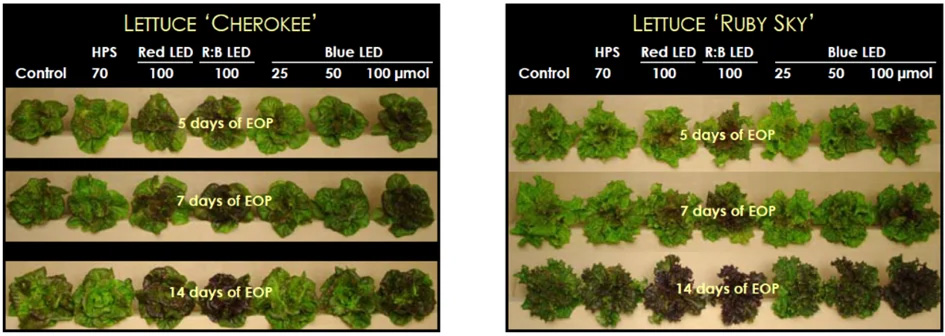
Image Source: Dr. Roberto G. Lopez, Michigan State University 2020
Results
Dr. Lopez noted, “100 micromoles of either red, a combination of red and blue, or blue light led to increased anthocyanin production. However, the treatment that really provided the most intense coloration was a combination of red and blue at 100 micromoles.”
He continued, “Even within five days, we see [in the images above] that the crop obviously looks much better than the control. So, our conclusion is that anywhere from five to seven days of the end of production supplemental lighting at 100 micromoles promotes the red pigmentation of lettuce. This is becoming used throughout the world in terms of enhancing color with lettuce when you have relatively low daily light integrals.”
LED grow lights provide today’s growers with the ability to customize spectrums of light to fit various plant growth applications. They can provide the right light for your crops at each growth stage while taking into consideration your greenhouse’s natural seasonal light.
Want naar learn meer?
Get je copy van geïntroduceerd eBook: Sneller hoogwaardige, winstgevende voedselgewassen produceren.
Neem contact met ons op!
Van lichtplanning op maat tot offertes op maat en alles daartussenin,
ons team van tuinbouwexperts staat altijd klaar om te helpen.